Just a reminder to all the 25 contributors whose poems came out in the 2006 Silver Issue. If you have not gotten your complimentary copies yet, please email me your mailing address (ramblingsoul@yahoo.com). The people from the PLAC will send you your copies. But if you are anywhere near the Katipunan area, I can meet you early next year and hand over your copies. Thanks.
By the way, Caracoa 2006 is being sold in mag:net Katipunan and will be available in Aeon Books by January. It's only P100. Bili naman kayo. Salamat at Manigong Bagong Taon sa lahat!
Friday, December 29, 2006
Wednesday, December 27, 2006
Desiderio, The Afflicted
by Karl De Mesa
Had he been lucid he would have been the first to affirm that, yes, his state did not lack for exegetes. If only he could remember which superlative went where and belonged to which field, he would have had the time of his life.
One thing was certain: he was no longer among the lucid.
Often, he would wake to find his sheets soaked in blood. He would rush to the bathroom and wash himself until the small soap they gave him every morning was reduced to the size of his pinky.
His screams were routinely ignored. This only increased his rage. When the fury reached breaking point he would toss himself against every surface until he forced himself to calm down again, forced himself to befriend the walls and the floor and the bed. “Look! Look how I bleed!” he would declare and he would raise his wrists and try to lift his feet as well.
Of course the wounds were not there. They always retreated from day, dissolved by
the same light that had transformed him. It was different when night came. If only they could see him at such times, he would show them and then they would see, they would acknowledge his apotheosis.
He doesn’t remember what he had first prayed for, but he does remember that he had clasped his hands and bowed his head to the Lord ever since he got here. Somewhere down the line he became lost in devotion. The light, engulfing him, showed him the wickedness of his heart, the wickedness of those around him.
That day, his change could not be denied. To himself, that is.
This change could only be seen from within. Its mark on his flesh, the night wounds, was a continuing reminder that his doubts still lay claim to him in some small measure. Such a testament was insufficient for the nurses and doctors. Still, there was no other option. So he continually called to them when the wounds came, hoping they would see, hoping they would recognize. Until then they insisted he swallow pills and commanded electricity to heal him.
In this place light behaved erratically, shadows fell where they shouldn’t -- the chiaroscuro of things was reversed. Medicine, that bitter cocktail, was the only clock by which he judged the time.
Today, there was still enough light to discern the person who came in with the 6PM cup of pills. But there was one glaring mistake: the woman had become a man. This was not logical. Perhaps it was another trick of his gaolers? If it was, it was by far the most ingenious.
“Desi,” the man who had entered said, and approached.
He didn’t answer.
“Desiderio de la Cruz,” the man looked at a rectangular metal tablet in his hand.
Desi did not acknowledge him. He continued to stare at the bedpan at the foot of his bed. It was in the man’s way, but it was also concealed since it was colored so much like the off-white of the floor and the walls. The man would surely stumble on it or, if Desi was lucky, trip and break his nose. So far it didn’t look like he had noticed.
Although there was a bathroom in Desi’s room he had insisted they give him a bedpan –a steel and aluminum arinola. He had a weak stomach and his bowels were weaker still. Sometimes he didn’t reach the toilet before his guts burst. To force them to give him a bedpan he had taken to defecating on the floor. This proved to them his urgent need.
The man stood fuddled over his metal tablet. Today, Desi knew there were no feces inside the bedpan. It was covered, yes, since he had just pissed there a few minutes ago, piss yellow and rank from this afternoon’s pineapple juice.
He made a bet for the next minute: the man would notice the bedpan and sidestep it or the bedpan would remain unnoticed. It would take the man approximately five steps to reach the foot of the bed from where he stood.
Desi rooted for the bedpan.
Meanwhile, the man continued to look at his metal tablet as he walked forward. “Desiderio, how do you feel today? I’m your new doctor, my name is Dr. Herodya. Sorry for the confusion but management says we better rotate with you every month since you don’t seem to be responding to treatment. Anyway, I have a nice glass of gin-buko right here.” The Doctor shook the plastic cup in his hand where pills rattled within. “Hello? Do you know where you are, Desi?”
The Doctor took a step forward. Outside, the sun was going down at an alarming speed. It would be dark before the bet could be completed.
“Do you remember how you got here? Why you’re here? Anything at all?”
Another step.
Desi’s eyes widened as he mentally urged the Doctor to walk faster. The Doctor stopped.
“Desi? Can you hear me?”
No! No! Don’t stop! Take another step! He cleared his throat, “I hear. Desi cannot.”
“Oh? Why not? You have ears. Don’t you, Desi?”
It seems he must take a hand in the proceedings, “I have, but I am not he. He was a sinful man.”
The Doctor took a step forward. He stopped a few inches from the bedpan. “Then who are you?”
He shook his head and said to the Doctor, “He is not I.”
“Who are you?” The Doctor asked again, “Who are you if not Colonel Desiderio de la Cruz?”
The enemy clearly had the upper hand but Desi’s will was stronger. Was he not a soldier of the Lord, a commander who served the glorious Host? He knitted his brows and willed with all his might. Willed the doctor to lift his foot and put it in front of the other. Walk, Doctor, walk! The Doctor took a step forward and stumbled right into the bedpan. He knocked over the cover and spilled piss all over his polished leather shoes, right through to his white socks.
“Shit!” the Doctor said in a surprisingly crisp tone.
Doctor Herodya cursed again as Desi laughed. He sat back on the bed. He held his belly and enjoyed the mirth. Sunlight completely faded and the light on the ceiling automatically turned itself on.
The light. The memory of living and dying for a brief second. The pull of a trigger. Only God could have saved Desi’s men. Only God could have made the bullet ricochet across his helmeted temple, knocking him from the path of the rocket that quickly followed and allowing him to survive. To survive even as the shrapnel and explosion cut to ribbons the Sergeant and three Privates behind him. His men. He had ordered them to get as much cover as they could, but the terrorists knew just where to hit them, and just when. The enemy. They had been waiting.
He wasn’t God, you know. No. Not then. Not yet.
“You know who I am,” he said to the Doctor.
Desi cast aside the blanket and stretched out his legs to show him the red pinpricks on his feet that oozed blood. He held up his arms to display his twin, bleeding wrists. Desi wondered if he had the halo around his head as well. He would have given anything for a mirror but the awed, horrified look in the Doctor’s eyes was enough.
Meanwhile, the Doctor was about to burst from an inner quake. The cup of pills in his hand rattled to a rapid beat. It began from his piss-soaked shoes and rapped its percussion against his immaculate white pants, his ballooning torso, up to his tiered and three-chinned face. The tremor set the glasses on his nose askew. It knocked at his skull, whipping his thinning hair from side to side as if he was being slapped. Unable to contain the mystery before him, the Doctor averted his eyes.
He rushed out of the room, knocking over the bedpan again. He threw aside the cup as he opened the door. Pills scattered. The Doctor’s footsteps and his scream echoed down the corridor to clamor with the other petitions in the dark.
Desi put down his arms and smiled at the bedpan. It lay on its side, its cover a foot away.
“You won,“ he told it.
It wobbled to say that, indeed, it had.
***
for discussion, E103

Monday, December 18, 2006
Caracoa 2006: The Silver Issue (UPDATED)
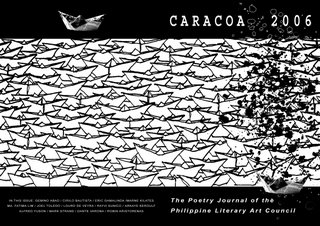
WHAT: Caracoa 2006: The Silver Issue Book Launch
WHEN: Friday, December 22, 2006 7pm
WHERE: mag:net Katipunan
CARACOA REVIVAL ON PLAC's 25th YEAR
Caracoa: The Poetry Journal of the Philippine Literary Arts Council
(PLAC), sees a revival after a ten-year hiatus with the launch in
Mag:net Katipunan at 7pm this Friday, Dec. 22, of Caracoa 2006: The Silver
Issue.
The younger generation of outstanding poets writing in English took the
initiative to revive what had been the longest running poetry journal
in the country as well as in Asia, which was started in the early 1980s
when it came out regularly as a quarterly.
The last issue, however, was produced in 1996, after which Caracoa
became moribund. Poets Joel Toledo, Lourd de Veyra, Angelo Suarez and Mookie
Katigbak sought permission from two of PLAC's founders, Gemino H. Abad
and Alfred A. Yuson, for the revival, for which the young poets
constituted themselves into an editorial board.
25 fresh voices comprise the contributors for the revival issue, which
also commemorates PLAC's 25th anniversary.
These contributors will help launch Caracoa 2006 with a reading of
their featured poems.
The Caracoa journal designer Pancho Villanueva will exhibit five of his
artworks, three of which are featured in the revival issue, on the
night of the reading-launch.
A couple of freshly minted CDs — of poetry readings conducted by the
original PLAC crew in the 1980s, including Abad, Cirilo F. Bautista,
Alfrredo Navarro Salanga, Ricardo M. de Ungria and Yuson, will also be
made available during the event.
The poets' band Chupacabraz, composed of Israfel Fagela, Joel
Toledo, Mikael Co and Carljoe Javier, will also perform after the reading.
Caracoa's revival was made possible with the help of David Guerreo,
Esq.of BBDO Guerrero Ortega.
(Mag:net Cafe is located along Katipunan Ave, Quezon City fronting
Miriam and Ateneo beside ibank and Rustan's with Tel 9293191 or visit
www.magnet.com.ph)
Caracoa 2006 features poems from 25 poets:
1. Alexander Agena
2. Jim Pascual Agustin
3. Ivy Alvarez
4. Oscar Alvarez
5. Glenn Atanacio
6. Amado Bajarias
7. Luis Cabalquinto
8. Mark Cayanan
9. Frank Cimatu
10. Mikael De Lara Co
11. Vincent Coscolluela
12. Adam David
13. Raymond de Borja
14. Rodrigo dela Peña
15. Israfel Fagela
16. Eduardo Geronia, Jr.
17. Luisa Igloria
18. Ken Ishikawa
19. Arkaye Kierulf
20. Sarge Lacuesta
21. Paolo Manalo
22. Wilfredo Pascual
23. Jose Ocampo Reyes
24. Naya Valdellon
25. Joel H. Vega
Finally, we're setting sail! Everyone's invited.
If you're a contributor, please bring poems to read.
Tuesday, December 05, 2006
¾
Certainly not as complex as math, and much simpler
than metaphor. Just something visual and comprehensible
and somewhat circular, like a pie from childhood
and how we had wanted it so badly, loving the challenge
a sister or brother posed, everything in favor of
that youthful right to the bigger share.
We call it greed every so often, getting old,
watching children fight over some silly object.
Common competition, we say, and how back then
we should always win. But how hard can it be
to let go of the transgressions? Even now
we are remembering our own incompleteness,
knowing at last that there’s so much the universe
still owes us: quarter moons and acute angles and just
too much sea. So we smile at the children
building sandcastles along the edges of water,
impatient for their own coming of age.
We coax them into the water oh so gently,
we would seem almost innocent. Now we are waiting
for them to call to us, to discuss with us sciences
and fractions and the deep and vast oceans of the world,
the insignificant domains of land and how to swim,
to love the fair and the unbroken sun above.
If only to fill them in on things, if only to get even.
Saturday, November 25, 2006
Is it I, Lord? Is it I?

re-post from cos' blog. haha.
Btw, please come on Monday, November 27, 8pm.
Chupacabraz at mag:net Katipunan
with, ika nga ni Goma, poetries by:
1. Angelo Suarez
2. Larry Ypil
3. Arkaye Kierulf
4. Allan Pastrana
5. Mookie Katigbak
6. Sarge Lacuesta
7. Marie La Vina
8. Cos Zicarelli
9. Sonny Sendon
en manny more sorprays gezs
Nood na!
Monday, November 20, 2006
Patrick Rosal at mag:net
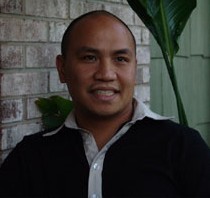
Inviting everyone to attend the one-night-only bboy poetry reading of Fil-Am poet Patrick Rosal tomorrow, November 21 (Tuesday), 8PM at mag:net, Katipunan. I will be reading with other guest readers including Asha Macam and Mookie Katigbak. See you there.
Patrick Rosal is the celebrated author of Uprock Headspin Scramble and Dive (Persea Books), finalist for the Asian-American Writers' Workshop Literary Awards and winner of the AAWW Member's Choice Award. His chapbook Uncommon Denominators won the Palanquin Poetry Series Award. His work has appeared in journals such as North American Review, Columbia, Folio, and many anthologies including The NuyorAsian Anthology, Pinoy Poetics, and The Beacon Best. He has been a featured reader at many venues around the country, in Buenos Aires, London, and on the BBC radio program "The World Today". The 2001 Emerging Writer in Residence at Penn State Altoona, he is currently Assistant Professor of English at Bloomfield College. My American Kundiman, was recently published by Persea Books in fall 2006.
-----
The Poet with His Face in His Hands
You want to cry aloud for your
mistakes. But to tell the truth the world
doesn't need any more of that sound.
So if you're going to do it and can't
stop yourself, if your pretty mouth can't
hold it in, at least go by yourself across
the forty fields and forty dark inclines
of rocks and water to the place where
the falls are flinging out their white sheets
like crazy, and there is a cave behind all that
jubilation and water fun and you can
stand there, under it, and roar all you
want and nothing will be disturbed; you can
drip with despair all afternoon and still,
on a green branch, its wings just lightly touched
by the passing foil of the water, the thrush,
puffing out its spotted breast, will sing
of the perfect, stone-hard beauty of everything.
-- Mary Oliver, from The Best American Poetry 2006 (I got a copy
yesterday from Booksale. hehe.)
Saturday, November 18, 2006
Bridport Prize 2006

Truly an honor. Many thanks to judge Lavinia Greenlaw and Bridport's Frances Everitt. Here's the Bridport Prize's updated link and here's what Ms. Greenlaw has to say about the winning poems. Awarding is tomorrow in Dorset, UK. The support has been tremendous, but I couldn't go and receive the prize myself as my daughter's currently confined and we don't know the final diagnosis yet. Anyhow, congratulations to all the winners, both for Fiction and Poetry. :)
Advanced call for submissions: Deadline for the next Bridport Prize is June 30th 2007. Judges are (wasak, wasak) Don Paterson for Fiction and Tracy Chevalier for Poetry. O nga, parang baligtad yata; dapat Paterson for Poetry and Chevalier for Fiction. Let's see if they still correct this. But that's what the Bridport Prize website says.
Thanks so much to Ms. Mons Romulo Tantoco for helping me secure my passport and to the wonderful people in the British Council for the help with the VISA. Pasensya na po talaga, di nakaalis.
Thursday, November 09, 2006
Time
Someone once said, it's been with us
since the beginning, incorruptible and blameless
as the electricity that rides the sky
and pushes the children away from the swing,
to fear then unhappiness, as they stare out
of windows like the rain will always be
their greatest bully. Nothing we do
can console them, like the small and nearby
were already the wide and friendly world,
as if outside should be swings and seesaws
and permanent sunshine. As if their whole lives
would rest on the same axis: our presence
and their resistance. Meanwhile,
we do what we can. We count the spaces
between lightning and thunder, the intervals
of rain and sun, time. So that our children,
alive with their bursting blue souls,
could once again leave us inside,
staring out of windows and growing even older.
Friday, November 03, 2006
Contact
To be sedated, handled with fingers,
the fear conquered and the animal harmless
like the ordinary orchids in the greenhouse,
its body just another thing to be tampered with.
I think of the young zoologist, his first time
in the field, lab work and books behind him,
hands calloused from too many chemicals.
How his body shudders now, this moment
with the animal of his wildest dreams.
It could be a lion, rhino, some poisonous snake.
It really doesn’t matter. He is caught
in this moment of pure closeness. He holds its paws,
hooves, wings, the pointed and useless fangs,
rough but firm like his grandmother’s hands,
as during that first trip to the zoo one summer,
a long time ago, before he forgot how
the sun exposes everything, alights gently
on the living, or the dead, and how everything ends up
being touched, even the fierce ones, even this animal—
for now familiar, for now almost like family.
Thursday, November 02, 2006
Poems with Crickets
Life
They made it clear from the beginning–
you were only borrowing it for a while,
and have to surrender it eventually,
like an umbrella from the neighbors after the rain.
Some, inclined to science and a mild form of pontification,
guessed life to be most likely linear, one straight path
from one moment to another, or crooked,
depending on which religion you’re looking from, and even concentric also,
like the growth of a tree’s bark, the future
containing the past in small circular hearts.
It was the really concerned ones, willing to be honest,
your mother most probably, or cousin, who said
happiness was hard to come by,
but attainable and never-ending and short.
What they didn’t tell you was that the sky overhead
was already gathering around the horizon and beautiful forever,
the grass underfoot growing around your feet
from graves. Of course you don’t have to know why.
You can always pray and sleep under trees.
What they didn’t tell you
was that you were given a body
weak to the hard elements but indestructible
as long as there was the soul chittering
like a cricket in the wide, boundless night field
outside your window, now apparently wet,
it having just rained, the neighbor’s umbrella
propped on your door, unreturned,
black with red polka dots, not your favorite color.
-- Arkaye Kierulf
Atonement
Where they are exactly, no one knows.
It is enough that they lie somewhere,
slicing the darkness with their sharp sounds.
Far off, in the cities, people are making do
with light and music and wakefulness.
Here, it is not so different. Only here,
the fireflies are satisfied with their nature,
their flickering envy of stars.
The same is true of the bullfrog,
announcing its presence by the pond,
and of the waiting owl, wide-eyed
and dark-winged and silent in the tree.
But the crickets, weak and ready
for the taking, are the boldest,
frantic with their unlinear music
as if they want to be found, as if
each singular blade of grass contains a single note,
contributes to the grand monotone of the evening.
Troubled and sleepless, I step out to look for them,
flashlight in hand. But outside there is only
the unblemished night, alive with its occasions of light,
harsh sounds, and the unseen crickets, nearby
and far away, mocking the frog, the owl, me.
As if their chorus is both for death and deliverance,
or simply because the night would be too silent
without their sacrifice. Eventually, they would
be discovered. Maybe not tonight, and maybe not
by me. This is the call of both the wild
and the human: our constant search for sources,
answers. Then again, there is the question
of God, our natural need to be heard, forgiven,
as these crickets–-noisy but perhaps
full of prayer, perhaps already redeemed.
-- Joel M. Toledo
Saturday, October 28, 2006
Dusting
These things moving in wind,
we have names for them. Feather, dust,
bird. That which, now and then, urges leaves
to nudge the moveable branches. Sometimes,
we may even see their quiet collisions,
flecks of sudden and minute life
as this afternoon, sitting on the porch
and watching my wife dusting off blankets,
the sunlight gathering around her lithe body,
our children running under the swayed trees
and the startled birds, the dust swirling joyously
everywhere, celebrating their release. And I am held
in awe of the things that move in the world,
or are moved, and of the privacy of the living,
the many rising objects revealed only by refraction,
and why I just sit here, straining.
Friday, October 20, 2006
Chupacabraz at mag:net katipunan
Monday, October 23. Show starts at 8pm with Poetry Reading by various poets from UST including Angelo Suarez, Cos Zucarelli, and Eric Melendez. Come one bayaw, com all bayaw!
Wednesday, October 11, 2006
Chupacabraz at Purple Haze
WHEN: Friday the 13th of October, 9PM
WHERE: Purple Haze Bar, T. Morato cor. E. Rodriguez, QC
Mga bayaw at hipag, manood naman kayo at maki wasak!
WHERE: Purple Haze Bar, T. Morato cor. E. Rodriguez, QC
Mga bayaw at hipag, manood naman kayo at maki wasak!
Thursday, September 21, 2006


Monday, September 11, 2006
The Plight of Poetry (or: What The Professors Did To Poetry)
interesting essay.
Bruce Deitrick Price
September 4, 2006
Quick, name a famous living poet. I bet that 99.99% of Americans can’t do this. When I was a boy, they actually interrupted pop music on the radio to say that T. S. Eliot had died. Can you imagine this today? Once the lusty Queen of the arts, Poetry now seems dithering and irrelevant. What happened?
I can do this in 10,000 words but we’re all in a hurry, right? The pretentious and sententious mugged Poetry. Mostly professors, lots of professors. There were also the highbrow critics such as Clement Greenberg, who lamented that middlebrow culture was “infecting the healthy, corrupting the honest and stultifying the wise.” Here’s what he and his friends were saying: if you don’t like what we tell you to like, you’re not entitled to like anything at all. Instead of encouraging people to participate as much as possible, even if only a little, and thus lifting the whole society, Clement & Co. undercut the process. Our self-appointed elite is good at the stilted, the mannered, the brainy, the opaque, the ingeniously pointless, so that’s the genius stuff. Everything else is deemed unworthy.
Fifty years ago we still had great and greatly famous poets. But after World War II, the universities swelled in number and size, and professors swelled with ambition. Poetry got kidnapped by publish-or-perish careerists (because universities count poems as “scholarly publications”). MFA programs claiming to teach the “craft” of poetry--never mind that it’s an art--sprouted like mushrooms. Dozens of little magazines, subsidized by university budgets and infused by academic hauteur, claimed to present true poetry. A small group (were there even a thousand of these people?) wrote, published, reviewed, praised, and gave awards to each other’s poems, all the while sniffing disdain at anything from outside their circle.
***
Sure, there are always culture snobs. In moderate doses it’s a fine thing--keeps the intellectual pot boiling, makes life interesting. But when think-alike extremists take over, you can kiss your art goodbye. And this is no short-term phenomenon. As early as the 1980’s, the generic poetry stamped out by academics already had a sardonic name: the McPoem.
McPoems, we might say, are to Poetry what chamber music is to music. Let’s concede that great skill is required to create chamber music, there is beautiful chamber music, and many people do love chamber music. The problems start if you pretend that chamber music is the only kind of music. Well, that kind of snobbery doesn’t go far in the music world, but it got disastrously far in literary land.
McPoems are usually genteel to an effete degree. Which would remind many of the New Yorker, so rich and influential, so enamoured of McPoetry. I confess that I’ve had a long love-hate relationship with Eustace Tilley’s Mag. The cartoons made me laugh. The poems often left me dazed: Are there actually people who enjoy this?
Whereas McPoetry is usually tired and gauzy, great poetry is typically energetic and lucid. Opaque poetry? Unless it’s at the level of Ezra Pound and Wallace Stevens, let’s not go there. (Billy Collins, a poet laureate, crafts his poems so they can be understood on a first reading; you can guess that McPoets hate this guy.) The language of great poems is generally intriguing on its own; but typically you fall through the language into the story or epiphany. No story or epiphany? Why write? And great poetry almost always gives you a grin or a chill, a sigh or a shudder. They’re emotional. McPoems tend to murmur faintly.
Who today writes with vigor and emotion? Our songwriters may be the exemplars. One of the pleasures of being in a Karaoke bar is to really study the lyrics on the screens, study them as if they are great poetry. Some are. You just know, if they published a book of Recent Poetry That Actually Made Somebody’s Heart Beat Faster, most of it would be by the Beatles and 50 other rock and rollers, Tin Pan Alley wordsmiths, blues and country singers, rappers, and other outcasts.
***
So, here’s what the McPoets accomplished: a torrent of boring poetry gave Poetry a bad rep. To judge by the proliferation of websites, more people may be reading long-dead Romans than are reading any American poets alive. What’s certain is that writers such as Catullus and Martial are perused with more visceral enjoyment than virtually all contemporary poets, because the dead guys are alive with sophistication and high spirits.
Poems from the Greek Anthology seems also to be more popular than ever. Wow! These poets wrote about every facet of life, including enemies, lovers, battles, and favorite boats. Here’s what poetry was like when it was young:
On a Thessalian Hound (by Simonides)
Even as you lie dead in this tomb
I know the wild beasts
still fear your white bones, huntress Lycas;
your bravery high Pelion knows,
and splendid Ossa
and the lonely peaks of Cithaeron.
Point is, this ancient poetry displays a directness, a force, a fullness of life that literature has traditionally possessed but McPoems abandoned. Just as they abandoned lightness (the kind that ballerinas possess) and a sense of fun. e. e. cummings shows how to do it right:
since feeling is first
who pays any attention
to the syntax of things
will never wholly kiss you;
wholly to be a fool
while Spring is in the world
my blood approves,
and kisses are a better fate
than wisdom
cummings also gave us a remarkable poetic credo: “It is with roses and locomotives (not to mention acrobats Spring electricity Coney Island the 4th of July the eyes of mice and Niagara Falls) that [poems] are competing.”
***
Horace, a Roman, wrote a long Ars Poetica full of sensible advice to the young writer. Fast forward 2000 years: Archibald MacLeish wrote another Ars Poetica, quite short, quite bizarre. This one has probably been quoted a million times in various McPoem Academies. It starts:
A poem should be palpable and mute
As a globed fruit,
Dumb
As old medallions to the thumb...
Poems should be mute and dumb? So gloriously goofy. Twenty years ago, when McPoems were practically blocking out the sun, I wrote my own Ars Poetica in self-defense. Here’s all of it:
oh to uncage words
as startling as birds
naked and silken
full of song and shriek
flung into the envious air
on a wonder of wings
to spin and soar and rise
dazzling our days
with surprise
MacLeish tells you how to write McPoems. I tell you: there’s other roads. But what the hey, I love these lines by Gelett Burgess:
I never saw a purple cow,
I never hope to see one;
but I can tell you, anyhow,
I’d rather see than be one!
Perhaps you feel the same way...but you’re afraid to admit it? Well, there’s some good in getting older and cranky. I no longer care what professors and cultural commissars think. Here’s advice I gave elsewhere about art: “Don’t be intimidated. If you don’t like it, it’s bad. If you like it, it’s good. Buy it.”
Another of my favorite lines is something I found, decades ago, scrawled on a vending machine in the New York City subway:
Let my red hot lips kiss your blues away
But here we are, pathetic losers. For the first time in the history of the world, in the most word-filled, endlessly communicating society ever, there’s hardly any literary hot lips.
***
Coda: Other people have made these same laments. Perhaps not as stridently. But they probably wanted to be respectable. I just want to set you free. First, ignore most of what comes out of academia until they stop being so pretentious. Second, spread yourself around, gather your literary rosebuds as you may, practice that diversity the universities love so much to talk about but don’t always get around to practicing. More than anything else, open up your heart! Let the works in. That’s all any writer or artist can ask. If you then decide, no good, that’s no problem. Don’t apologize, keep looking. There’s so many talented people, in this country and around the world. You’ll love many of them. Find them, and take them home with you.
source: http://www.americanchronicle.com/articles/viewArticle.asp?articleID=13154

Friday, September 08, 2006
Miriam Bboy Crew
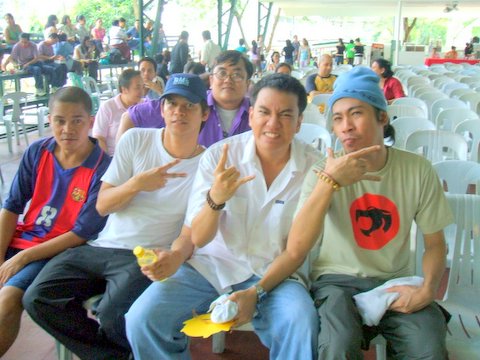
Coach Sims aka BBoy Soccer, Peter aka BBoy Pedro, Lope aka BBoy Malopet, at si BBoy Ztorm.
Salmat kay Sir Jose Leonidas aka BBoy Magix for the photo!
Monday, August 28, 2006
Animal!
Live, Wild, and Roaring!
Purple Haze Cafe, T. Morato
Video by Ibba Rasul (ibbaisms.blogspot.com)
Tuesday, August 22, 2006
Subscribe to:
Posts (Atom)