Thursday, June 22, 2006

Almost There

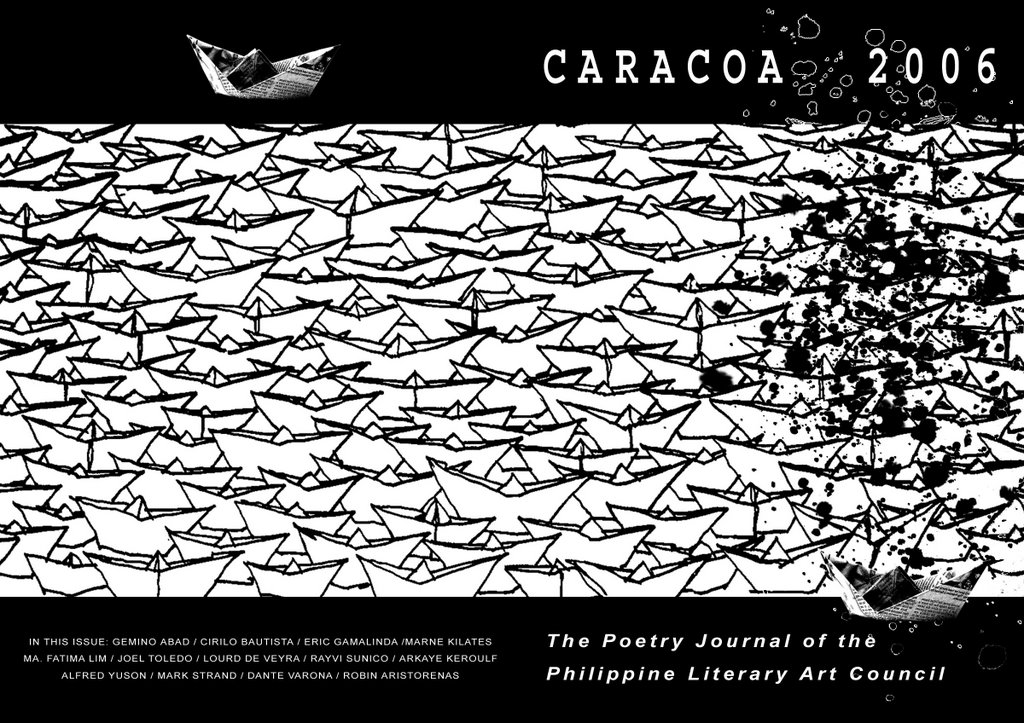
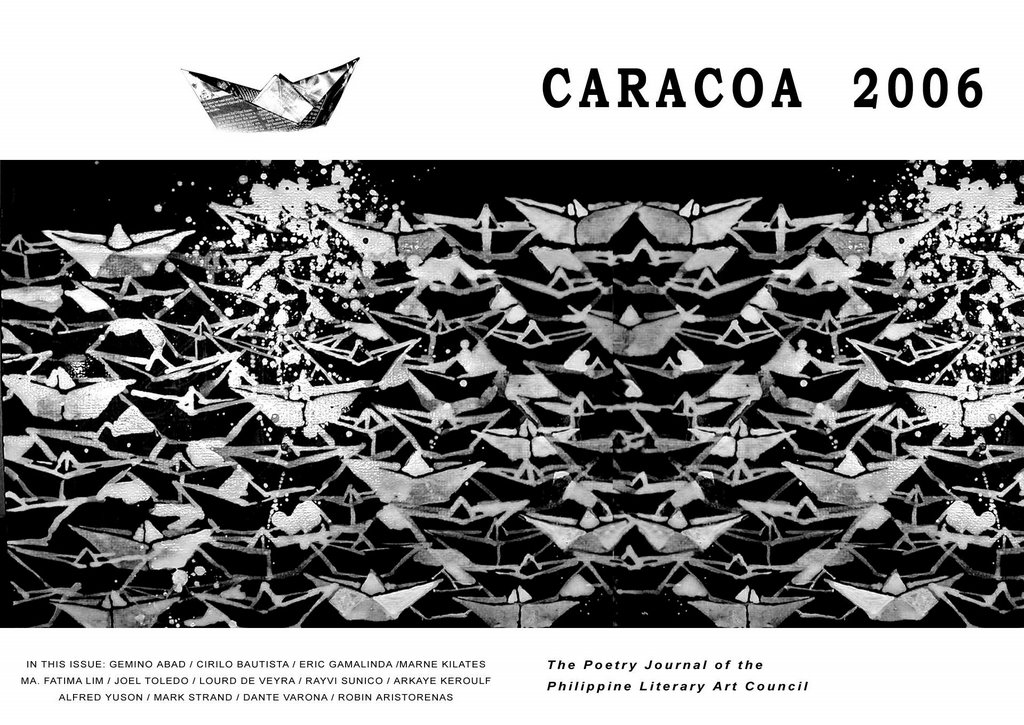
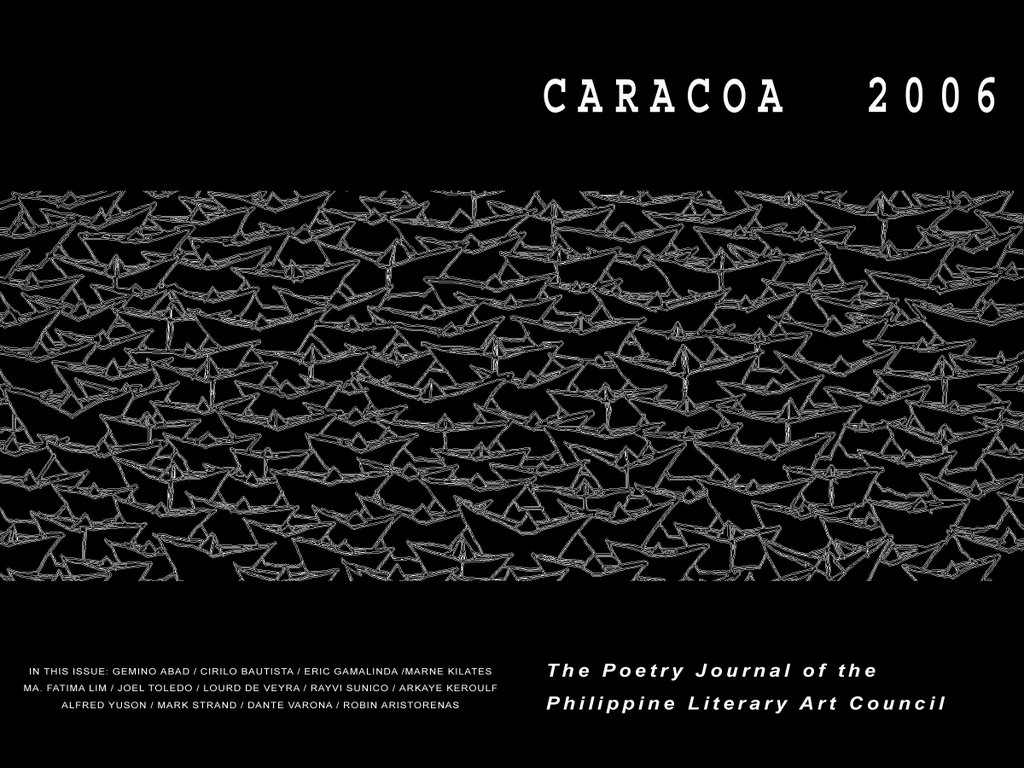
Here are some studies Pancho Villanueva came up with for the Caracoa cover. Konti na lang, papalaot na! Pardon the missing s sa ArtS. Concepts pa lang naman. Ayuz!


Friday, June 09, 2006

First Day Funk


pls drop by for a few. not yet in the list but will also read is lourd de veyra.

Thursday, June 08, 2006

Hack-a-Shaq


Opens Tomorrow-- The Onion

Tuesday, June 06, 2006

The Mercy of Lazarus

Groggy, sure, and in the midst of bad dreams,
it must have been a dispirited awakening -
expecting everything settled, the long night
without interruption suddenly interrupted,

like a four A.M. alarm bell but worse, the rock
rolled back, to be called forth, told to pick up
the yoke, to pay your bills, get the roof fixed,
to become a bit of proof in the lord's affidavit.

Now the crowd pushes forward, demanding
to hear your cries of thanks. If you refused,
crawled back to your tomb, well, their hope,

lately upraised, would need a tomb of its own.
Where would be His miracle without your deceit -
your laugh and eager shout, the outstretched arms?


Stephen Dobyns
Mystery, So Long
Penguin, 2005

Sunday, June 04, 2006

Wednesday, May 31, 2006

Winding Up

I live on the water,
alone. Without wife and children,
I have circled every possibility
to come to this:

a low house by grey water,
with windows always open
to the stale sea. We do not choose such things,

but we are what we have made.
We suffer, the years pass,
we shed freight but not our need

for encumbrances. Love is a stone
that settled on the sea-bed
under grey water. Now, I require nothing

from poetry but true feeling,
no pity, no fame, no healing. Silent wife,
we can sit watching grey water,

and in a life awash
with mediocrity and trash
live rock-like.

I shall unlearn feeling,
unlearn my gift. That is greater
and harder than what passes there for life.


-- Derek Walcott

----

Thanks to all those who texted me this morning.
And a million thanks to my panelists Paolo, Chingbee,
and Sir Neil. Mabuhay kayo!

Tuesday, May 30, 2006

Caracoa 25

Hereunder is the list of 25 poets chosen for the 2006 revival issue of the Caracoa. We received submissions from 71 poets and we had a tough time trimming the list to 25. The works of those who were not included in this revival issue will be forwarded to the upcoming Caracoa anniversary issue which will come out within the year or early 2007. We are now working on the design and layout of the book. To all those who submitted, thank you very much for contributing and for keeping the Caracoa afloat.

The Editors

------------
1. Alexander Agena -- Lady in an Imaginary Painting
2. Jim Pascual Agustin -- Those Who Still Have Black Blood Under Their Feet
3. Ivy Alvarez -- The Elephant
4. Oscar Alvarez -- Economy Class
5. Glenn Atanacio -- Journey of Flowers
6. Amado Bajarias -- Artifacts 2 / Happiness in Other Planets
7. Luis Cabalquinto -- Details
8. Mark Cayanan -- As Dina Bonnevie
9. Frank Cimatu -- The Manifest Destiny Routine, or My Fetid Sestinna
10. Mikael De Lara Co -- Tongues
11. Vincent Coscolluela -- Church of the Meek
12. Adam David -- Instructions for the Inclined: Help Found A Writing Org
13. Raymond de Borja -- Tell Me, Where is the Soul
14. Rodrigo dela Peña -- Algebra
15. Israfel Fagela -- Condolences
16. Eduardo Geronia, Jr. -- Surfing in these Islands
17. Luisa Igloria -- Minim / Archipelago
18. Ken Ishikawa -- End of a Frontier
19. Arkaye Kierulf -- Horses
20. Sarge Lacuesta -- Modern Girls
21. Paolo Manalo -- Weekend Couple
22. Wilfredo Pascual -- A Filipino in the Charlie Brown Musical
23. Jose Ocampo Reyes -- Glimpses
24. Naya Valdellon -- New Year at the Wake
25. Joel H. Vega -- Interiors

Monday, May 29, 2006

Books 15

Rush Sale. Pick-up on June 1, Thursday, 2pm, Fruit Magic, Katipunan. But if you can get them earlier, the better (like tonight; sobrang walang pera eh hehe). just email me thru ramblingsoul@yahoo.com or leave a comment. thanks!

-------------
1. Neil Gaiman: Anansi Boys (HB) -- P600
2. TS Eliot, The Invisible Poet (Criticism) -- P300
3. Poems on the Underground (HB Anthology) -- P400
4. Italo Calvino: Numbers in the Dark and Other Stories -- P400
5. Jessica Hagedorn: The Gangster of Love(Uncorrected Proof) -- P450
6. The Penguin Rhyming Dictionary (Poets, Writers, Slogans)-- P400
7. Writers at the Movies: 26 Authors on 26 Movies (Carson, Baxter, Coover, Dobyns,
Hirsch, Moody, Raab, Rushdie, Simic, Sontag, etc.) -- P450
8. Seamus Heaney: Electric Light (Poems)P400
9. Don Paterson: Landing Light (HB Poems) -- P400
10. Thomas Lux: Split Horizon (Poems) -- P300
11. Raymond Carver: When Water Comes Together with Other Water (Poems)-- P350
12. Andrew Hudgins: Babylon in a Jar (Poems) -- P200
13. Jorge Luis Borges: Labyrinths -- P400
14. England's Dreaming: Anarchy, Sex Pistols, Punk Rock & Beyond -- P700
15. Jorie Graham, Essays on the Poetry (by Thomas Gardner/Hard to Find) -- P1,000

Tuesday, May 23, 2006

To The Soul

Is anyone there
if so
are you real
either way are you
one or several
if the latter
are you all at once
or do you
take turns not answering

is your answer
the question itself
surviving the asking
without end
whose question is it
how does it begin
where does it come from
how did it ever
find out about you
over the sound
of itself
with nothing but its own
ignorance to go by


W. S. Merwin
Migration: New and Selected Poems
Copper Canyon Press 2005

Thursday, May 18, 2006

Saturday, May 13, 2006

Reminder: Caracoa 2006 Deadline May 15

Those interested have until 6pm on Monday (May 15) to submit one to two unpublished poems with a short bio info of the writer. Caracoa 2006 will publish the works of 25 poets for this 25th anniversary issue. Works by poets who have not been previously published in the Caracoa are preferred. Thanks!

The Legend of 'Howl'

In which one ecstatic, idol-shattering poem heralded the '60s counterculture--and spawned the myth of its own radical break with the past
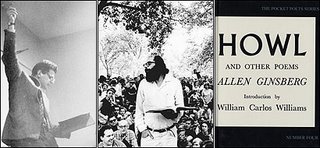
Allen Ginsberg (left) reading in San Francisco on Nov. 20, 1955, and (center) in New York City's Washington Square Park on Aug. 28, 1966. At right, the City Lights Pocket Poets edition of 'Howl and Other Poems.'


By David Barber | April 30, 2006
The Boston Globe

POETRY MAKES NOTHING happen, Auden duly informs us, but when mythology takes over, anything goes. Or so it would seem, to judge by a new collection of essays, ''The Poem That Changed America: 'Howl' Fifty Years Later" (FSG), commissioned by Beat hagiographer Jason Shinder to mark the golden anniversary of Allen Ginsberg's epochal barbaric yawp.

Ever since ''Howl" first appeared in its instantly talismanic City Lights pocket edition in the fall of 1956, it's been hard to reckon where the poetry ends and the mythology begins. The Poem That Changed America? Never mind that there's no parsing such a blunderbuss hypothesis-the startling thing is that any poem at this late date can still have the kind of potent half-life in the collective imagination usually reserved for platinum pop hits.

When the legend becomes fact, runs the imperishable line in John Ford's ''The Man Who Shot Liberty Valance," print the legend. In the case of ''Howl," it was a seamless transition: The poem was already legendary before it saw the light of print.

In the standard telling, it all began with a thunderclap on what Jack Kerouac later called that ''mad night" of Oct. 7, 1955, in an erstwhile San Francisco auto-body shop converted to a Boho art gallery. That was the mad night Ginsberg took his turn on the orange-crate podium and declaimed his work in progress to the assembled ''angelheaded hipster" faithful, leaving the throng in an uproar and Beatnik paterfamilias Kenneth Rexroth in tears. That was the mad night that Ginsberg's full-throttle first line-"I saw the best minds of my generation destroyed by madness, starving hysterical naked"-burst into the American vernacular as the first and perhaps still unbested of countless generational war cries. That was the mad night that turned a spindly Jewish twentysomething from Jersey into a rock star avant la lettre, prompting ever-canny City Lights impresario Lawrence Ferlinghetti to fire off a telegram the next day that echoed Emerson's storied note to Whitman on the publication of ''Leaves of Grass" exactly a century earlier: ''I greet you at the beginning of a great career."

It's the stuff of fable, and it goes to show that there's nothing like a classic creation myth for industrial-strength staying power. That night has gone down in the annals as the official kickoff of the San Francisco Renaissance as a brand-name literary movement, but that's not the half of it. There was an earthquake that night, and it presaged the birth of the counterculture, the spawning of Sixties youth rebellion, and the annunciation of redemptive transgression as a radical social creed and a libertine fashion statement.

''Howl" was its epicenter, and the fault lines would be redrawn as battle lines practically overnight. By the time the revised text began to circulate far and wide as Beatnik samizdat, complete with a lionizing benediction by Ginsberg's old hometown mentor William Carlos Williams (''Hold back the edges of your gowns, Ladies, we are going through hell"), ''Howl" was already more of a landmark cultural artifact than a mere work of literature, the breakneck lines on the page barely able to keep up with the zeitgeist whirlwind they were reaping.

Pop culture chronology is of course the inverse of geological time-a year is an era and half a century is the rock of ages. It may appear more inevitable than ironic, then, that Ginsberg's brave new caterwaul was destined to be remastered as an Old School anthem.

The conclave Shinder has rounded up is a conspicuously mixed bunch (professors and pundits ranging from Marjorie Perloff to Andrei Codrescu jostle with assorted literati like Marge Piercy, Rick Moody, and former US poet laureates Billy Collins and Robert Pinsky) and the plan was clearly to size up the ''Howl" phenomenon from every conceivable angle ('''Howl' and the Language of Modernism," '''Howl' in Transylvania," ''The Poet as Jew"). Taken together, though, it all rather smacks of committee work, a laborious bureaucratic effort to affirm that ''Howl" is still everything it's cracked up to be, and then some. This predictably leads to a good deal of boilerplate prattle-"'Howl,' so perfectly titled, was coolness, madness, anger, and some of the secular beatitudes all wrapped into one poem," Collins chirps. Nevertheless, there's a suitably thoroughgoing remedial education to be had for those of tender years whose strongest recall of Allen Ginsberg may be as one of those dudes in the retro Gap khaki ads.

Despite some faint traces of disenchantment in the air, the festschift's prevailing tenor is pious, even starstruck, as the eclectic panel queues up to attest to ''Howl"'s totemic mystique and revolutionary vibe, albeit at times straining mightily to dissolve any contradiction between the poem's iconoclastic clamor and its canonic stature. That's mythic grandeur for you, but it's also a case of dutifully taking the poet at his own word. ''In publishing 'Howl,"' Ginsberg avowed in a brief retrospective piece the anthology reprints under the oddly poignant title ''I've Lived with and Enjoyed 'Howl'," ''I was curious to leave behind after my generation an emotional time bomb that would continue exploding in US consciousness in case our military-industrial-nationalist complex solidified into a repressive police bureaucracy."

. . .

In the face of such commemorative fanfare, it almost seems churlish to retort that the time bomb has come to more closely resemble a time capsule. That's not to say ''Howl" and its cult following haven't had a china-rattling cultural impact: There's no arguing with the archival evidence that the poem administered a genuine shock to the body politic and body poetic alike. But what if its unreconstructed acolytes have it exactly backwards, and the enduring allure of ''Howl" has less to do with its groundbreaking raw language, and its rip-roaring sales pitch for a new brand of antiestablishment enlightenment, than with what a defiantly old-fashioned poem it is? What if its ''powerful resonance today," as the anthology's flap copy trumpets, is an elegiac rather than a prophetic echo, a last gasp instead of a clarion call?

We are talking about a poem, after all, that's modeled on ancient prosodic blueprints, bardic and Biblical: the litany, the psalm, the dithyramb, the catalog. It's a poem whose original working title was ''Strophes," knowingly harking back to the incantatory template of Attic choral odes and Athenian tragedies. It's a poem inescapably cosponsored by those two magisterial 19th-century rhapsodists, Blake and Whitman-and not merely in its impassioned appropriation of their soundtracks (great rolling cadences, cascading refrains, margin-busting line measures) but also their mindscapes (ecstatic hyperbole, cosmic visions, declamatory speechifying). Its hyperventilating denunciation of ''Moloch" as the personification of the soul-corrupting social order (''Moloch whose mind is pure machinery! Moloch whose blood is running money!") is a trope straight out of Old Testament scripture; its feverish ''Footnote" (''Holy the groaning saxophone! Holy the bop apocalypse!") is nothing less than an amped-up liturgical chant. We are talking about a poem, in other words, that's animated by the most atavistic article of faith in the book-the power and glory of poetic utterance itself.

The party line on ''Howl" pays lip service to all this, but what's seldom owned up to is how dolefully retrograde it now feels to take Ginsberg's explosive poem-any poem-on those sacramental terms. It's safer to exalt ''Howl"'s vehemence at the expense of its earnestness; it's easier to buy into its subversive scatalogical explicitness than to put stock in its subversive absence of irony. A San Francisco magistrate's ruling in the 1957 City Lights obscenity trial that the poem has ''some redeeming social importance" assured that its uncensored publication would go down as a thumping victory for trash-talking free speech and fire-breathing political dissent, and yet in another sense it was a coup de grace: Enshrining ''Howl" as a social manifesto seems to have had the irreversible effect of embalming it as a period piece.

''The appeal in 'Howl' is to the secret or hermetical tradition of art 'justifying' or 'making up for' defeat in worldly life," Ginsberg later wrote, but the erudite ring of that remark is just one more chastening reminder of how the spirit in which his poem was conceived has been swallowed up by the theatrical spectacle of its public acclaim. The notoriety of Ginsberg's opus as an all-purpose, pocket-sized rite of passage-part do-it-yourself kit for demolishing taboos, part passport to polymorphous permissiveness-scarcely afforded ''Howl" the fighting chance to earn its keep as a poem. Indeed, it's hard to dispel the impression that the most dated thing about the poem is that it is a poem.

So are ''Howl"'s latter-day adherents succumbing to false nostalgia in proclaiming the poem as a national monument? Not at all: The nostalgia is genuine. It's surely wishful thinking to imagine that poetry was ever close to the center of American public life, but in the clear light of hindsight it sure looks like it was within closer hailing distance once upon a time than seems remotely plausible today. If Ginsberg's message has stood the test of time better than his medium, that may be the real secret as to why his dirge still touches such a raw nerve. Poems don't set our ears on fire like that anymore, and they know better than to even try.

David Barber is poetry editor of The Atlantic
Study: Alligators Dangerous No Matter How Drunk You Are

May 10, 2006 | Issue 42•19
The Onion

BATON ROUGE, LA—In a breakthrough study that contradicts decades of understanding about the nature of alligator–drunkard relations, Louisiana State University researchers have concluded that people's drunkenness does not impair the ancient reptiles' ability to inflict enormous physical harm.

Photo: Drunkard Jim Boudreaux taunts the alligator he called "a total pussy" in front of friends.

Alligators exhibit the potential to inflict serious harm, regardless of the blood-alcohol levels of their victims.

"Our data strongly indicates that human intoxication does not transform an alligator into a docile creature that enjoys wrestling," said professor Ryder McCrory, chair of the Wildlife Taunting Department of LSU's prestigious Center For Bullying And Hazing Studies. "Despite its slow-witted demeanor and tendency to bask motionlessly in the hot sun, it's a mistake to believe that an alligator will passively tolerate a half nelson, no matter how much Southern Comfort is fueling it."

McCrory said the study yielded statistics that speak for themselves.

"In 10 out of 10 documented cases of violent alligator–drunkard encounters, the reptile was not influenced by the fact that the victim was 'just kidding' or 'just having some fun,'" McCrory said.

To an alligator, McCrory explained, a human forearm, even drunkenly dangled between the creature's casually opened jaws, still appears to be prey.

In field experiments, members of the control group performed no better-—and often far worse—than their sober counterparts in defending themselves against a 300-pound, seven-foot bull alligator. Even when armed with an empty tequila bottle.

"At best, the bottles bounced harmlessly off the alligator's snout," said LSU research assistant Tracy Sawyer.

When placed in water, the drunken volunteers fared even worse, and the alligator markedly better, Sawyer said.

In addition, the alligators far outperformed their inebriated human counterparts in the following areas: lunging, biting, crushing, dismembering, and swallowing.
Enlarge ImageAlligator and Drunk

According to the study, an alligator's characteristic grin should not be interpreted as a lighthearted reaction to the outrageous nerve of an alcohol-addled human. "Don't let an alligator's easygoing appearance fool you," Sawyer said. "These creatures have no empathy for drunken pranksters looking for fun. They are not black bears."

McCrory recommended that alligator wrestling be undertaken solely by professionals, specifically roadside-attraction proprietors. For drunkards interested in proving their mettle with alligators, the researchers proposed these guidelines:

Instead of baiting an alligator, seek another form of drunken recreation, such as attending a strip club, burning a pile of tires, or painting one's buttocks with a funny face and videotaping it.

Sick or infant deer are considered a far safer match for most inebriated humans; kicking a raccoon or squirrel already dying by the side of the road is also recommended.

Experts suggest that those who become aggressive after consuming alcohol would be safer channeling that energy into more constructive behavior, such as calling an ex-lover.

And McCrory warned drunkards who "absolutely must assault an alligator while inebriated" to first make sure it is not a John Deere Gator cargo utility vehicle. This oversight "is a common occurrence," he said.

Tuesday, May 09, 2006

New Wave Naman...

we'll be as we are
when all the fools who doubt us
fade away
-- "Hollow Horse"
The Icicle Works

Friday, May 05, 2006

Monday, April 10, 2006

(Updated) Call for Submission: Caracoa 2006


*mga prends, paki-link/update naman ito sa mga blog n'yo. thanks! :)


Caracoa, the official literary publication of the Philippine Literary Arts Council (PLAC) and the longest-running journal of poetry in English in Asia, is now accepting submissions for Caracoa 2006.

The return of Caracoa marks the 25th anniversary of the PLAC. It will be the first Caracoa anthology to come out in almost ten years.

There is no specific theme for this issue. Those interested should submit two unpublished poems in English via email (word attachment only) thru caracoa2006@yahoo.com. Deadline for submission is May 15, 2006. Those submitting should include their contact info and a brief bio-data.

Caracoa 2006 will showcase the works of 20 to 25 poets and will be guest edited by Lourd De Veyra and myself along with a group of other poets writing in English. Caracoa 2006 is targeted for publication this coming June (not September as originally posted), and will be the first in what is envisioned to be a semi-annual publication of the journal.

About the PLAC

PLAC or Philippine Literary Arts Council was founded in September 1981 by prominent English-language poets Gémino H. Abad, Cirilo F. Bautista, Alfrredo Navarro Salanga, Ricardo M. de Ungria and Alfred A. Yuson.

The group edited and published Caracoa: The Poetry Journal of the Philippine Literary Arts Council, until it became a regular quarterly by the mid-1980s, with funding and administrative support provided by British businessman and writer Michael Adams.

Intermittent funding led to sporadic release in the 1990s, until the heretofore last issue, Caracoa 96, theme-titled "Heroes & History," which came out in 1996 as part of the start of the Philippine Centennial celebration. It was actually the 27th issue of the poetry journal published within a span of 15 years.

By then PLAC had expanded its membership to include notable fictionists in English, so that its roster of membership read as follows.

Honorary Fellows: Carlos A. Angeles, Franz Arcellana, Tita Lacambra Ayala, Erwin E. Castillo, Ricaredo Demetillo, Ophelia A. Dimalanta, NVM Gonzalez, Edna Z. Manlapaz, Bienvenido N. Santos, Edith L. Tiempo and Emmanuel Torres.

Associate Fellows: Cesar Ruiz Aquino, Juaniyo Arcellana, Ma. Luisa Aguilar B. Cariño, Fidelito C. Cortes, Jose Y. Dalisay Jr., Simeon Dumdum Jr., Marjorie Evasco, Felix Fojas, Eric Gamalinda, Cristina Pantoja Hidalgo, Marne Kilates, Susan Lara, Clovis Nazareno, Charlson L. Ong, Danton Remoto, Ramon C. Sunico, Cesare A.X. Syjuco, Ma. Fatima V. Lim-Wilson and Ruel S. de Vera.

The Founding Fellows still comprise the Board of Trustees, with the exception of the late Freddie Salanga.

Outstanding thematic issues of Caracoa have included: Caracoa 1 featuring early works by PLAC's founders; Caracoa 3: Nine Women Poets (October 1983: Isabela Banzon, Bing Caballero, Ma. Fe Rhodora A. Espinosa, Ma. Linda Felipe, Fanny Haydee B. Llego, Priscilla C. Supnet Macansantos, Ma. Annella Manalo, Grace R. Monte de Ramos and Marjorie E. Pernia); Caracoa 4: New Voices (July 1984: Ramon Bautista, Fidelito Cortes, Francis C. Macansantos, Clovis Nazareno, R. Torres Pandan, Victor Jose Peñaranda and Ernesto Superal Yee); Caracoa 5: Sub Versu -- An Anthology of Poetry in Protest (November 1984); Caracoa 6: Eros -- Poems of Love and Desire (February 1985); Caracoa 7: Breaktext -- Poems Dancing on Their Heads (May 1985); Caracoa 8: Genius Loci: Poetry of Place (August 1985); Caracoa 9: Meta -- Of God, Death & Beyond (November 1985); Caracoa 10: R+A+D+I+O (February 1986, featuring the first poetry collection of Ricardo M. de Ungria); Caracoa 11: Coup d'EDSA -- Poems on Freedom (May 1986); Caracoa 15: Ex Patria; Caracoa 17: Women of Letters (January 1988); Caracoa 20: In Memoriam: Alfrredo Navarro Salanga (November 1988); Caracoa 22: GAIA: Versecology -- In Celebration of Earth Day 1990; Caracoa 24: Flipside -- Poems on America (January 1991); and Caracoa 26/95: Gaudeamus (1995: A Collection for the 1990s of New Voices, Award-Winning Poems & Recent Works by Established poets).

The caracoa was a war vessel plying the waters off Mindanao and the Moluccas in the 16th century. The rowers stayed close to the hull, while the warriors stood with their spears on a platform. The poet sat alone at the far end of the boat, manning the rudder. He was neither rower nor warrior, yet he decided where the prow should point. His own thoughts knifed through the immense sea of his solitude, though the waters kept him company.

In him was rower and warrior; he himself was a double-decked vessel of grace
and irony. He was far back, yet he provided direction. At times the caracoa lost its way. No matter. The sea would still be there, and the shoals would still be duly recorded.

Monday, March 20, 2006

Fairly Legal


just got these photos c/o white rabbit Iwa Wilwayco. Los Chupacabras in the recent U.P. Fair! Rakenrol, mga bayaw!!!

*Note: If you look really close, you can spot the well-hidden attorney and an interesting display of band "synergy". Nyehehehe.

Tuesday, March 14, 2006

Extra! Extra!


Got a text from Augie Rivera about this. It's so friggin' funny, I just had to put it up. Get your copies now, people. And long live press freedom! Ahehe.

Manila Times headline today (March 14 2006):

Hooded ex-NPA fingers Dinky

Thursday, March 02, 2006

Mobo Modding


Itching to get myself at least a 6800GT video card to do this...

Wednesday, March 01, 2006

Ignorance of the Law is No Excuse

We were warned about spiders, and the occasional famine.
We drove downtown to see our neighbors. None of them were home.
We nestled in yards the municipality had created,
reminisced about other, different places --
but were they? Hadn't we known it all before?

In vineyards where the bee's hymn drowns the monotony,
we slept for peace, joining in the great run.
He came up to me.
It was all as it had been,
except for the weight of the present,
that scuttled the pact we made with heaven.
In truth there was no cause for rejoicing,
nor need to turn around, either.
We were lost just by standing,
listening to the hum of wires overhead.

We mourned that meritocracy which, wildly vibrant,
had kept food on the table and milk in the glass.
In skid-row, slapdash style
we walked back to the original rock crystal he had become,
all concern, all fears for us.
We went down gently
to the bottom-most step. There you can grieve and breathe,
rinse your possessions in the chilly spring.
Only beware the bears and wolves that frequent it
and the shadow that comes when you expect dawn.


John Ashbery
Where Shall I Wander: New Poems